Letters from Eleanor — Volume 2
Seaside, Florida
My dearest friend,
Yesterday afternoon, I watched a young mother riding her bicycle down the street with three children following behind her.
The youngest was pedaling furiously, determined not to be left behind. The middle child was talking without taking a breath, and the oldest was doing his best to look as though he had absolutely nothing to do with the other three.
I recognized the arrangement immediately. It reminded me of my own daughter learning to ride her bicycle on the streets of seaside and inadvertantly crashing into a car.
I once had a bicycle parade of my own as a young mom with 4 kids in tow.
And for one rather lovely moment, I was thirty-three again.
I've been thinking about that age quite a bit lately.
Thirty-three.
It's a peculiar age, isn't it? Old enough to believe you ought to have everything figured out, but young enough to be astonished when you discover you haven't.
When I arrived in Seaside in 1987, the town was only six years old.
Six!
Robert and Daryl Davis had begun building their little dream in 1981 with just two houses and a single street. They imagined a town where people might walk to the shops, sit on their front porches, and know the names of their neighbors.
A rather old-fashioned idea, even then.
And a rather wonderful one.
By the time I arrived, cottages were appearing among the trees, sandy streets led toward the Gulf, and the little post office had been standing for only a couple of years.
There were no crowds of people waiting to photograph its red doors. No bustling town center quite like the one we know today.
Just a small building with a very important job: connecting people to the rest of the world.
I rather liked that.
I had come to Seaside hoping to disconnect from mine.
Of course, I had no idea that I would eventually marry, raise children, and spend the greater part of my life in this little town.
Life has a way of making plans while we're busy making other ones.
I remember the first time I pushed a baby carriage along those sandy streets. The wheels were entirely unsuited to the terrain, and I arrived home looking as though I'd completed a rather ambitious expedition.
I remember little sandals lined up beside the front door, wet bathing suits draped over the porch railing, and the endless procession of sandy feet through my kitchen.
I remember birthday cakes, missing library books, scraped knees, and children who could never find their shoes when it was time to leave the house.
Oh and the sand castles, covering themselves with sand to become mermaids.
And I remember how certain I was that those days would last forever.
Of course, they didn't.
While my children were growing, Seaside was growing too.
In 1988, Modica Market opened, and the town began to feel a little more like the sort of place where you could run an errand and find yourself in three conversations before you reached the counter.
More cottages appeared. More families arrived. The streets became livelier, the shops multiplied, and the little community gradually grew into the town its founders had imagined.
And then Hollywood came calling.
You may remember The Truman Show, the film starring Jim Carrey that was released in 1998.
Well, Seaside was its picture-perfect setting.
Imagine that! Our little town, which had once seemed so far removed from the rest of the world, suddenly appearing on movie screens everywhere.
I remember thinking how peculiar it was that people were traveling great distances to see the place where we bought groceries and collected our mail.
But I suppose that's what happens when something lovely is discovered.
People want to share in it.
And share it they did.
Over the years, Seaside became busier. The quiet little streets welcomed more bicycles, more visitors, more families arriving with beach bags and great expectations.
There were new shops and restaurants, new traditions, new friendships.
There was more laughter.
And, I confess, considerably more difficulty finding a parking space.
Clara Bell maintains that the parking situation is a test of Christian character. I don’t disagree. However, the Seaside chapel still gives. out parking passes every Sunday.
I have suggested Clara Bell try riding a bicycle.
She has suggested I mind my own business.
Our friendship remains intact.
But as Seaside grew, something else was happening.
My children were growing up.
One by one, the bicycles became cars. The bedtime stories became conversations about college applications, first jobs, and people they thought they might love.
The little hands that once reached for mine began reaching for lives of their own.
And isn't that the strangest thing about raising children?
You spend years teaching them to be independent, and then one day, to your great surprise, they are.
I can still remember standing on the porch after the last one drove away.
The house was so quiet.
No music drifting from upstairs. No one asking what was for dinner. No shoes abandoned in the hallway.
I went inside and made a cup of tea.
Then I made another.
Neither helped very much.
For a while, I wasn't entirely certain who I was supposed to be.
I'd spent so many years being needed that I had forgotten what it felt like simply to be Eleanor.
I wonder whether you've ever felt that way.
Perhaps after your children left home. Or after a retirement, a move, or the end of a chapter you thought would last much longer.
There is a peculiar sadness in watching a good season of life come to an end.
Even when you know the next one may be wonderful.
Especially then, perhaps.
I found myself missing things I had once wished would hurry along.
The laundry. The noise. The constant interruptions.
I even missed the question, "What's for dinner?" which had been asked approximately fourteen thousand times without anyone showing the slightest interest in helping prepare it.
And then, quite gradually, something changed.
My children began coming home as adults.
They brought stories from places I'd never been. They introduced me to people who became part of our family. They asked my advice about things that mattered.
Sometimes they even took it.
They arrived with their own opinions, their own traditions, their own ways of doing things.
And I discovered that knowing your children as adults is an entirely different sort of pleasure.
You begin to see the people they've become, not simply the children you remember.
You admire their courage. You laugh at their stories. You learn from them.
And occasionally, when they say something particularly sensible, you wonder where on earth they learned it.
Naturally, you take the credit.
Just a few weeks ago, my son came home for a visit.
Now, I should explain that when your children are grown, their visits become rather precious occasions. You find yourself stocking the refrigerator with their favorite things and pretending you haven't been counting the days until they arrive.
During his visit, my son found himself in need of a can of WD-40.
I cannot tell you what he was attempting to repair. I have learned that when a grown man announces he needs WD-40, it is sometimes best not to inquire too closely.
Off he went to Modica Market.
Now, Modica Market has been part of Seaside since the late 1980s, when Charles and Sarah Modica opened their family grocery. These days, the next generation helps carry on the tradition, including their daughter Carmel.
My son went inside hoping to purchase a can of WD-40.
Instead, Carmel offered to lend him hers.
Just like that.
No paperwork. No deposit. No lengthy discussion about the proper use of household lubricants.
Simply one neighbor helping another.
And, of course, he returned it.
When he told me the story, I laughed. Not because there was anything particularly remarkable about borrowing a can of WD-40, but because it reminded me of the Seaside I first fell in love with nearly forty years ago.
Back then, we borrowed cups of sugar, watched one another's children, and knew which neighbor had a ladder tall enough to reach the gutters.
Today, the streets are busier, the cottages are more numerous, and people arrive from all over the world to experience this lovely little place.
But somewhere in the middle of it all, a woman whose family has helped shape this town for generations is still willing to lend someone a can of WD-40.
I think that's rather wonderful.
You can build beautiful houses and charming streets, but you cannot manufacture that sort of kindness.
It has to come from the people.
And perhaps that's what makes a town feel like home.
Not simply the place itself, but the quiet assurance that someone will be there when you need them.
Even if all you need is a little WD-40.
I began to discover things about myself, too.
I had more time to read, to write, to wander down streets I'd hurried along for years.
I renewed old friendships and made new ones.
I learned that a quiet house needn't be an empty life.
And I began to understand something about this little town that had grown up around me.
Towns are a little like people.
They begin with an idea of what they might become.
They grow. They change. They acquire character.
They become more complicated.
There are additions that delight us and changes we wish hadn't happened. Familiar faces disappear, new ones arrive, and sometimes we find ourselves missing a version of a place that exists now only in our memories.
But there is richness in all those years.
A street isn't simply a street once you've walked it holding a child's hand, ridden it on a yellow bicycle, and stood along it waving goodbye to someone you love.
A cottage isn't simply a house when it has held birthday parties, Christmas mornings, difficult conversations, and the ordinary Tuesdays that somehow become our most treasured memories.
And a town isn't simply a collection of buildings when it has witnessed the lives of the people who call it home.
Even our little post office has changed.
In 2018, it was moved from its longtime location along Highway 30A to a new spot beside Sundog Books.
Can you imagine?
After all those years, someone decided the old girl needed a change of scenery.
I watched with considerable sympathy.
Moving is no small undertaking at any age, particularly when one has become rather attached to one's surroundings.
But there she stands today, still recognizable, still useful, still welcoming people through those familiar red doors.
Different location.
Same lovely spirit.
I rather hope the same might be said of me.
I'm seventy-two now.
I have laugh lines I didn't have at thirty-three, a few more opinions, and a much greater appreciation for a comfortable pair of shoes.
I've learned that not every disagreement requires a response, that good friendships need tending, and that very few things are improved by worrying about them at three in the morning.
I've also learned that people are rarely as simple as they first appear.
Including me.
There are things I believed at thirty-three that I no longer believe.
There are things I once feared that I now welcome.
And there are decisions I made all those years ago that I still find myself thinking about when the house grows quiet.
Perhaps that's part of growing older, too.
We don't simply collect years.
We collect versions of ourselves.
The young woman who arrived here with two suitcases and a hatbox is still somewhere inside me. So is the mother who stayed awake waiting for the sound of a car in the driveway. So is the woman who stood on her porch wondering what to do with a suddenly quiet house.
I wouldn't want to lose any of them.
Not even the one who made mistakes.
Especially not her.
This morning, the same little family rode past the post office again.
The youngest child had fallen behind, and his mother had stopped to wait.
She stood beside her bicycle, one hand shading her eyes from the sun, watching him make his determined way toward her.
For a moment, I wanted to call out to her.
I wanted to tell her that one day those little bicycles would be gone, that the house would be quiet, and that she would give almost anything to have one more ordinary afternoon just like this one.
But I didn't.
Because I remembered how many well-meaning women had told me to enjoy every minute when my own children were small.
And I remembered how very tired I sometimes was.
So instead, I smiled and waved.
She waved back.
And they continued down the street together.
I watched until they disappeared around the corner.
Then I went inside, put the kettle on, and opened my desk drawer.
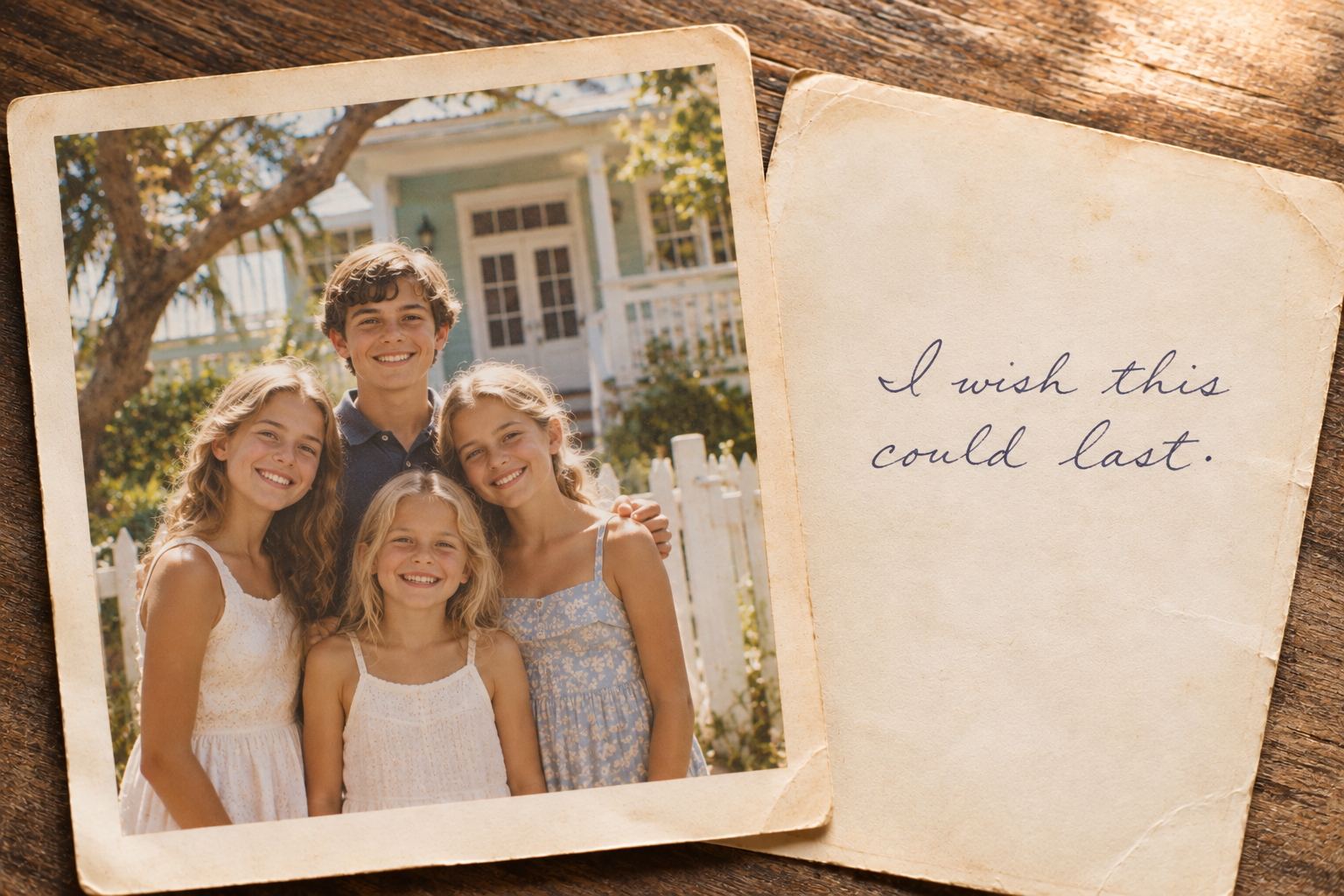
There, beneath a little bundle of old photographs, was a picture of my children standing in front of our cottage, all three grinning into the sunshine.
I hadn't looked at it in years.
I sat with it for a long while.
And then I turned it over.
On the back, in my own handwriting, were five words:
I wish this could last.
I smiled.
Because in a way, my dear friend, it has.
Not in the way I imagined.
But perhaps in a way that's even better.
With affection,
Eleanor
P.S. Clara Bell has just informed me that she intends to write a letter to someone about the parking situation. I reminded her that she has been threatening to do so for twelve years. She replied that she likes to give people ample opportunity to correct their mistakes before taking formal action.